

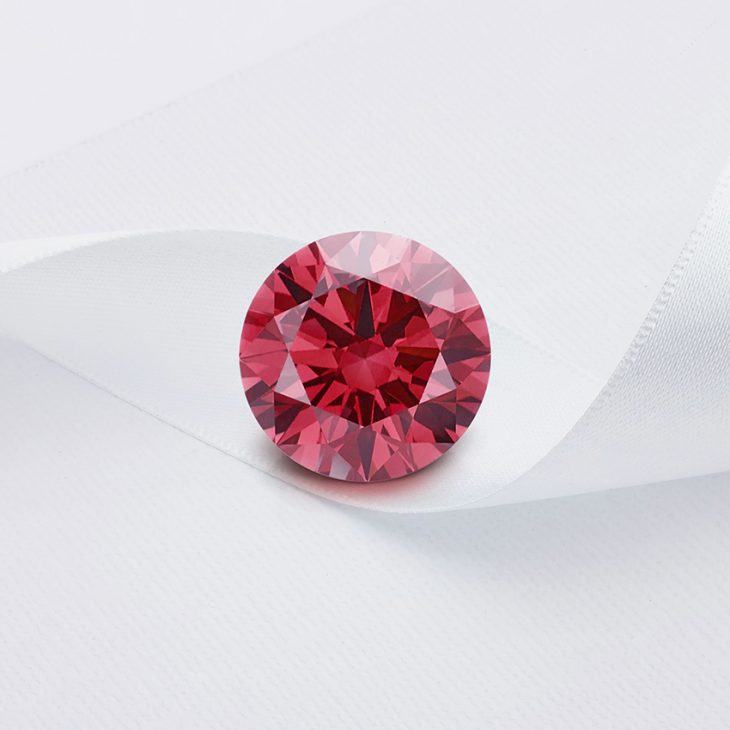
Ruby is July’s birthstone — a deep red gemstone prized for over two thousand years as a symbol of love, courage, and vitality. Formed from the mineral corundum and coloured by trace amounts of chromium, ruby ranks 9 on the Mohs hardness scale, making it one of the toughest gemstones available for everyday jewellery. Traditionally given to mark a 40th wedding anniversary, ruby remains one of the most requested gemstones for engagement rings, eternity bands, and bespoke designs.
If you’re shopping for a July birthday, an anniversary gift, or simply drawn to ruby’s colour, here’s everything worth knowing before you buy.
Ruby at a Glance
| Feature | Ruby |
|---|---|
| Birth Month | July |
| Colour | Red |
| Mineral | Corundum |
| Hardness | 9 (Mohs) |
| Anniversary | 40th Wedding Anniversary |
| Symbolism | Love, Courage, Passion, Strength |
| Main Sources | Myanmar, Mozambique, Sri Lanka, Madagascar |
What Is Ruby, Exactly?
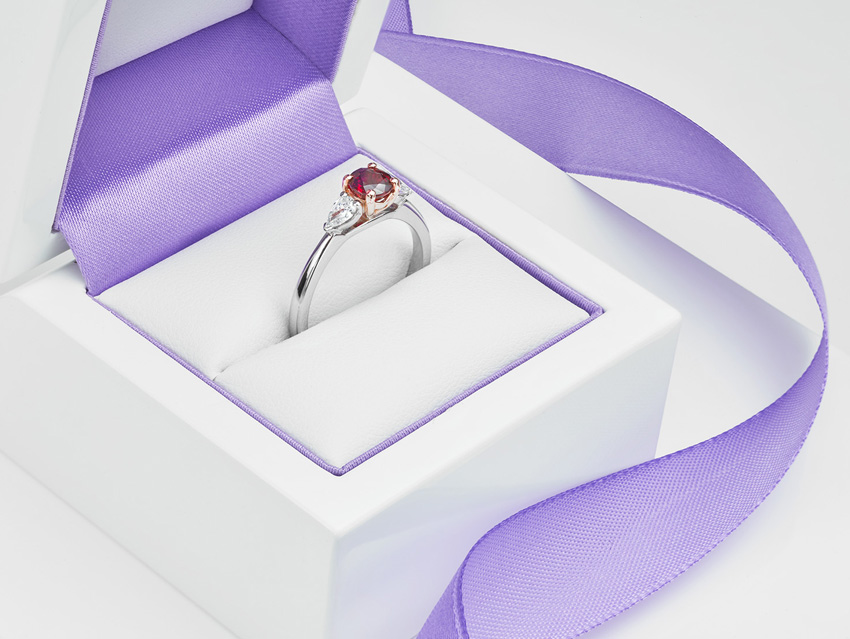
Ruby and sapphire are the same mineral — corundum — and colour is the only thing that separates them. In its purest form, corundum is colourless. It’s the trace elements locked into the crystal structure that determine colour, and in ruby’s case, that element is chromium.
The more chromium present, the more intense the red. Chromium can also cause fluorescence, which adds extra glow to the stone under certain lighting — part of why a fine ruby can look like it’s lit from within.
“Pigeon’s blood” is the trade term used for the most prized ruby colour: a vivid, slightly purplish red with strong saturation. It’s the benchmark collectors and gemmologists use when judging quality, and it commands a significant price premium.
A note on treatment
Most commercial rubies on the market today are heat-treated to improve colour and clarity — this is a long-accepted industry practice, not a defect, and it’s disclosed as standard. Untreated rubies of fine colour are rare and priced accordingly. If provenance and treatment history matter to you, always ask for this information before buying — we’re happy to talk you through it on any ruby we source.
The History of Ruby
The name comes from the Latin ruber, meaning red. Ancient cultures believed the stone held a flame burning inside it.
Ruby’s documented history stretches back over 2,000 years, with early trading routes through Myanmar’s Mogok Valley supplying gem markets across Asia. In Sanskrit, ruby was called ratnaraj — “king of precious stones.” Warriors in Burma were said to embed rubies into their skin or armour, believing the stone made them invincible in battle. Across multiple ancient texts, including several references in the Bible, ruby is treated as the most valuable of gemstones — a marker of wealth, power, and divine favour.
That reputation has barely faded. Ruby still tops the list of the world’s most valuable coloured gemstones, with the finest examples outselling diamonds of equivalent size at auction.
What Does Ruby Symbolise?
Ruby has consistently represented the same things across cultures and centuries: love, courage, passion, and strength. It’s associated with vitality and the “fire of life” — which is partly literal, given the way light behaves inside a high-quality stone.
Many also associate ruby with confidence and motivation, treating it as a stone that encourages boldness and joy. Whether or not you put stock in that, it’s a fitting gift for someone starting something new — a marriage, a milestone birthday, a fresh chapter.
Ruby vs Garnet vs Spinel vs Pink Sapphire: What’s the Difference?
Several gemstones share ruby’s red colour family, and it’s worth knowing the difference before you buy:
| Gemstone | Colour | Hardness | Typical Price Point |
|---|---|---|---|
| Ruby | Deep red to purplish-red | 9 | High |
| Garnet | Dark red, also comes in other colours | 6.5–7.5 | Affordable |
| Red Spinel | Vivid red, often mistaken for ruby historically | 8 | Mid-range |
| Pink Sapphire | Light to medium pink | 9 | Mid–High |
Garnet is January’s birthstone and the most common ruby alternative — rich in colour, widely available, and considerably more affordable.
Red spinel has a notable history of being mistaken for ruby; several “rubies” in royal crown jewels have since been re-identified as spinel. It’s a genuinely beautiful, durable stone in its own right.
Pink sapphire is chemically identical to ruby (both are corundum) — the only difference is colour intensity. A stone sits on the boundary between “pink sapphire” and “ruby” once it crosses a certain depth of red, which is partly why grading can get subjective at the margins.
Choosing a Ruby Ring
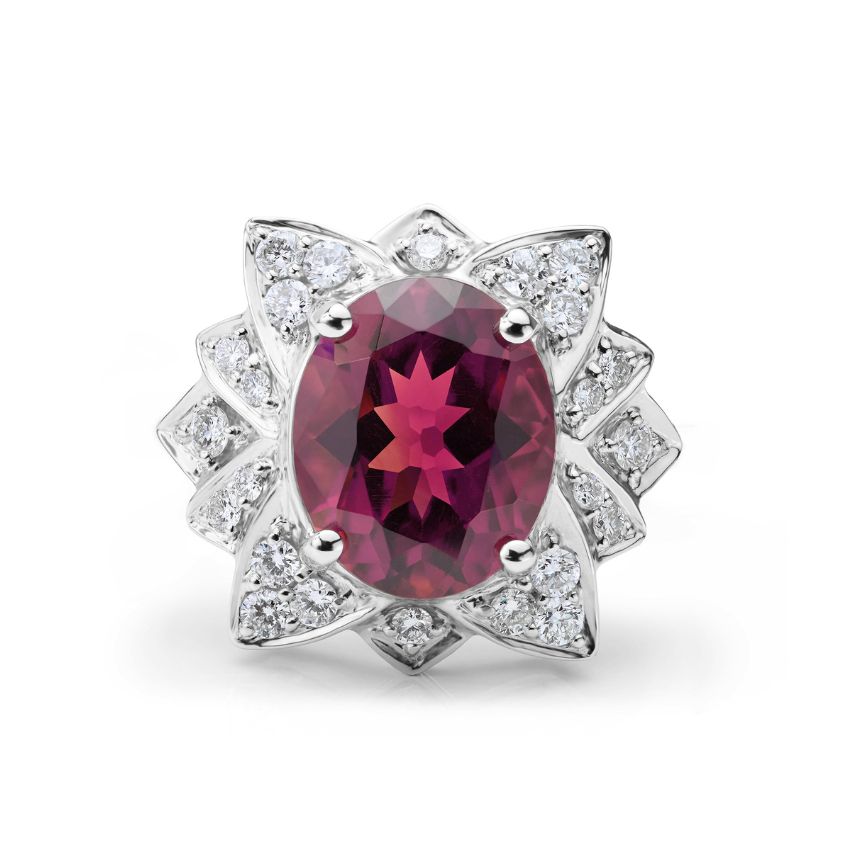
Ruby’s vivid colour and durability make it suitable for nearly any ring style:
- Solitaire — the classic choice, letting the stone’s colour speak for itself
- Halo settings — a ring of diamonds around a central ruby intensifies the contrast between deep red and brilliant white
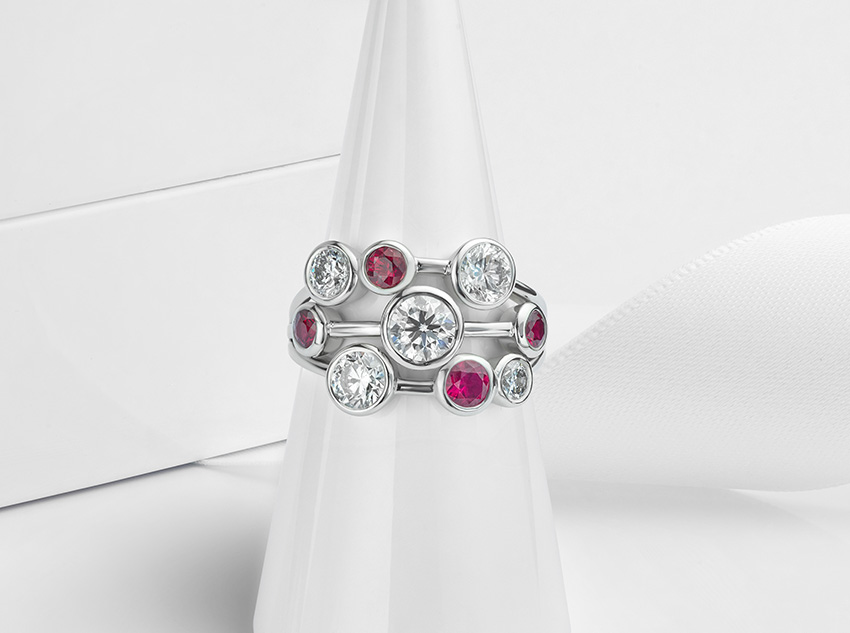
- Clusters — multiple smaller rubies grouped for a fuller look at a lower cost than one larger stone
- Vintage-inspired designs — typically set in yellow gold, which has historically been ruby’s most popular pairing and remains so in heritage-style commissions
Because ruby ranks 9 on the Mohs scale — just below diamond — it holds up well to daily wear, which is one reason it’s a popular choice for engagement rings as well as anniversary jewellery.
Case Study: Recreating a Lost Ruby Ring
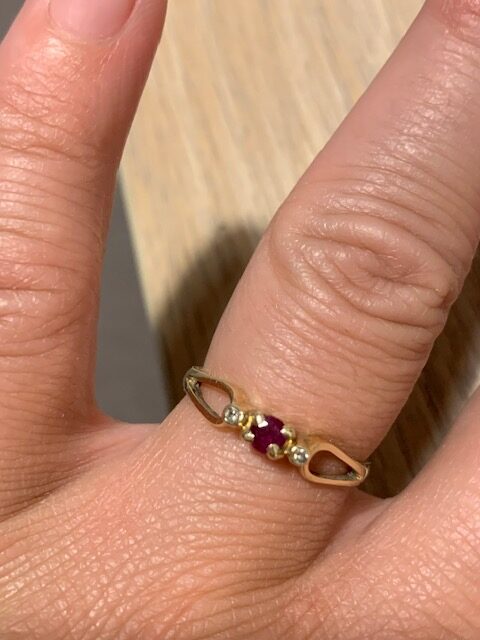
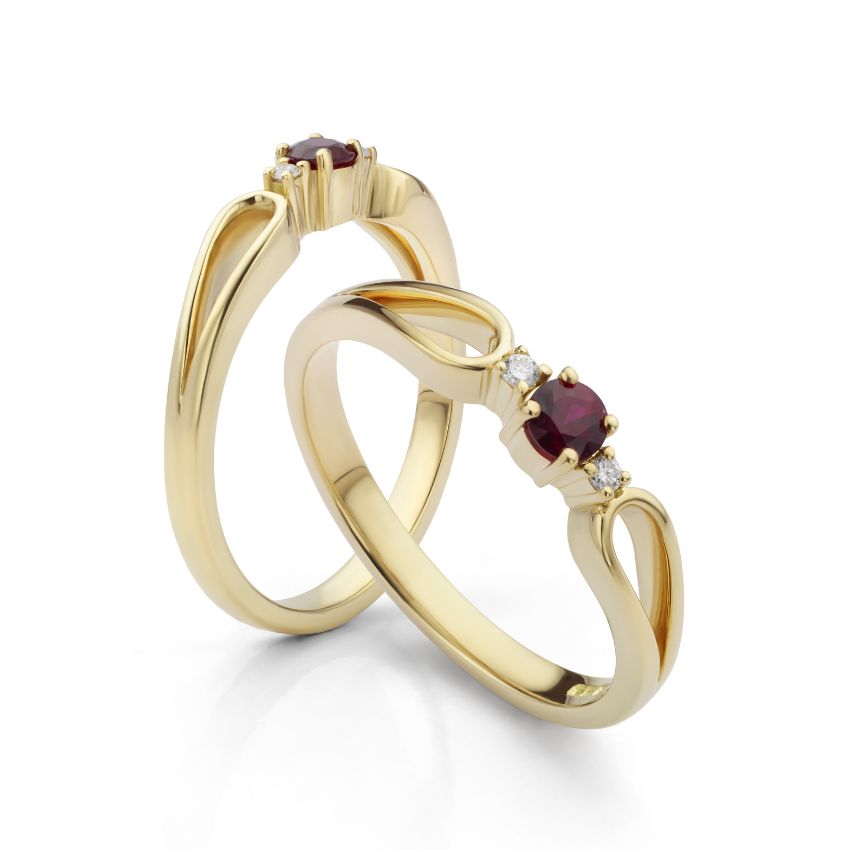
One of our most common bespoke requests is remodelling — upgrading the metal, the centre stone, or reworking an entire design. One client came to us after losing a ring that held significant sentimental value, with only a photograph to work from.
Working from that single reference image, our bespoke team rebuilt the design from scratch, matching the original stone setting, band profile, and proportions as closely as possible. The result was a faithful recreation of a ring the client had believed was gone for good.
It’s a good example of what’s possible through our bespoke ring design service — whether you’re recreating something lost, redesigning an inherited piece, or starting from a blank page.
Bespoke Ruby Statement Ring
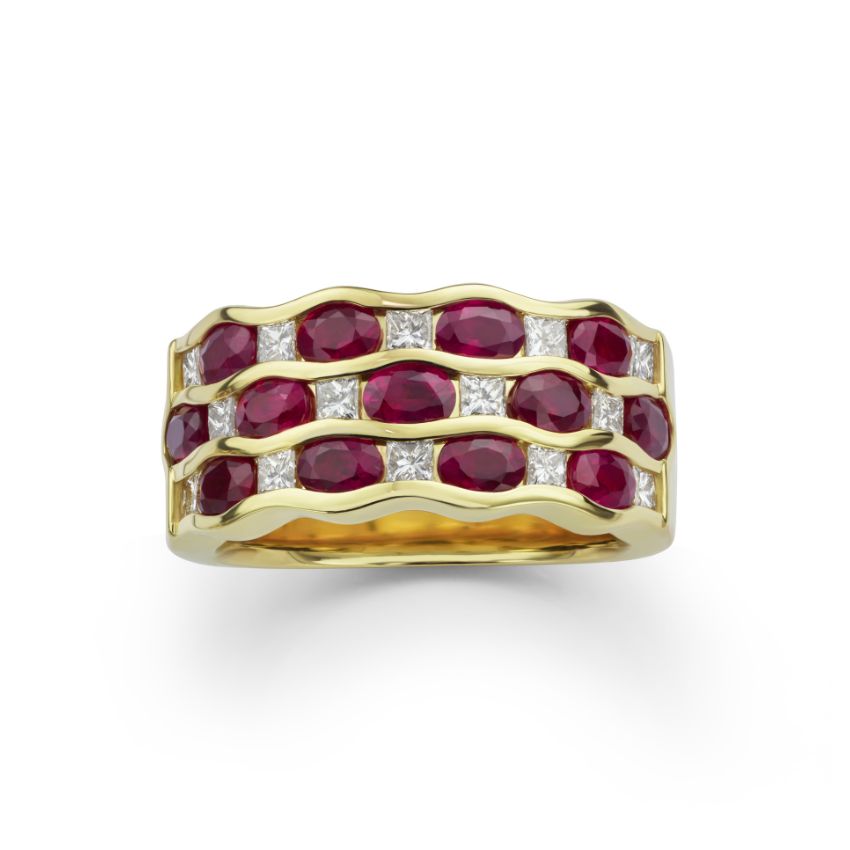
Bespoke Spotlight: Vintage Ruby & Diamond Statement Ring
This handcrafted piece was inspired by a vintage design pairing rubies with brilliant-cut diamonds. It features 2.55ct of oval-cut rubies alongside 0.70ct of princess-cut white diamonds, tapering from 10mm at the widest point to 6.5mm at the back of the finger.
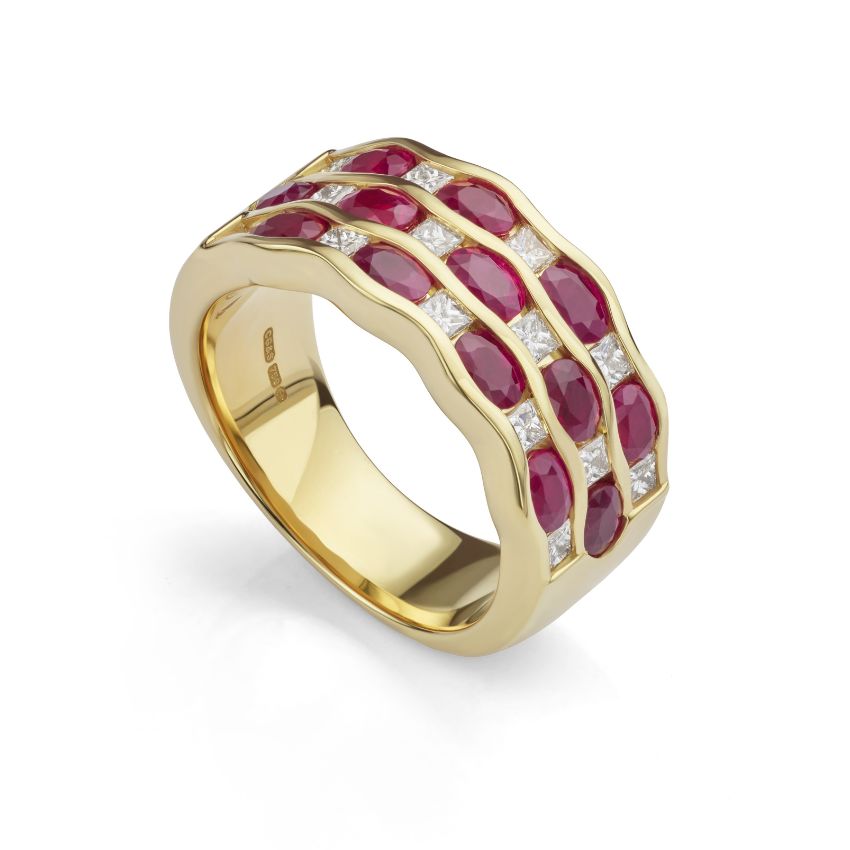
It’s the kind of design our bespoke service specialises in — distinctive, generously set, and built around the client’s own vision rather than a standard catalogue shape.
Gift Ideas for July Birthdays and Ruby Anniversaries
Solitaire Ruby Necklace — A 9ct yellow gold necklace on a 16″ chain, featuring a 4mm ruby in a six-claw setting. Available for immediate dispatch or collection from our Ryde showroom.
Ruby & Diamond Swirl Stud Earrings — Rubies set against 9ct yellow gold and white diamonds, finished with secure butterfly backs.
Ruby Halo Necklace — A central 5mm x 4mm oval ruby encircled by 8-cut diamonds, set in 9ct white gold. A fitting gift for either a July birthday or a 40th wedding anniversary.
All of the above can be personalised with free engraving, and most designs can be adapted through our bespoke service to feature a ruby of any size or shape.
Caring for Your Ruby Jewellery
Ruby’s hardness makes it low-maintenance compared to softer gemstones, but a few habits will keep it looking its best:
- Have prong settings checked periodically by a jeweller, particularly on rings worn daily
- Clean with warm water, mild soap, and a soft brush — avoid harsh chemicals
- Remove ruby jewellery before swimming in chlorinated water or applying perfume/hairspray
- Store separately from other jewellery to avoid surface scratches on softer metals
Frequently Asked Questions
What is the meaning and symbolism of ruby? Ruby symbolises love, passion, courage, and wealth, and has traditionally been associated with vitality and the “fire of life.”
How much is a ruby worth? Value depends on colour, clarity, size, and treatment. Fine rubies can range from a few hundred dollars per carat to several thousand, with exceptional untreated stones commanding the highest prices.
How can you identify a real ruby? Look for a deep red colour, strong clarity, and a hardness of 9 on the Mohs scale. Genuine rubies often show natural inclusions, which can help distinguish them from synthetic or simulant stones.
What are the best ruby mines in the world? Myanmar’s Mogok Valley is historically the most renowned source, alongside notable mines in Mozambique, Sri Lanka, Madagascar, and Thailand.
What’s the difference between a ruby and a pink sapphire? Both are corundum, and colour is the only distinction — ruby is a saturated red, while pink sapphire is lighter and pinker. The boundary between the two is a matter of colour grading rather than mineral composition.
Is ruby a good choice for an engagement ring? Yes — at 9 on the Mohs scale, ruby is hard and durable enough for daily wear, making it a popular alternative to diamond for engagement rings.
Explore more: Rainbow Rings: Red, Orange, Yellow, Green and Blue Diamonds | January Birthstone: The Beauty of Red Garnet | Disney-Inspired Engagement Rings
Ready to design your own ruby piece? Get in touch for no obligation bespoke quotation, or visit us at our Ryde showroom on the Isle of Wight.

About Mark Johnson
Mark founded Isle of Wight jewellers Serendipity Diamonds in 2007 after a career in the polished diamonds industry. Today he works in the Serendipity showroom, helping clients with jewellery, creating handmade designs and updating their two jewellery websites SerendipityDiamonds.com and Isle-of-Wight-Jewellery.co.uk